
Artificial Intelligence in IT : Ushering in the Era of Smart Solutions
What was once hailed as the "age of data" has quickly evolved into something much more powerful: the age of Artificial Intelligence (AI). Moving Beyond Automation—in recent years, automation laid the groundwork for progress, but now AI is driving the future. By using advanced algorithms and adaptive systems, machines are increasingly capable of replicating human-like behaviour. AI doesn’t just follow rules; it learns, improves, and makes decisions that rival or even exceed human capabilities in fields like programming, analytics, and data interpretation. So, we can say that AI will transform the near future in a way that we can never imagine.
AI’s Expanding Role in the UK
In the UK and similar regions, AI is no longer seen as a novelty; it’s now an integral part of everyday life and business operations. Around 70% of UK residents regularly use voice-activated tools like Siri or Alexa, integrating AI into their routines for everything from setting reminders to managing home devices. These smart assistants have become standard in customer service, altering how people shop, bank, and communicate. In public services, AI is being used by the National Health Service (NHS) to enhance care and efficiency. For instance, it helps predict which patients are likely to become frequent users of emergency services, enabling earlier intervention and more personalised treatment plans. The finance sector also benefits from AI’s capabilities, particularly in fraud detection, customer interaction, and risk assessment. AI systems trained on transaction patterns can identify suspicious behaviour with high accuracy, making banking more secure and responsive. Retailers are using AI to remain competitive and enhance customer experience across digital and physical touchpoints. Technologies like deep learning and computer vision are being used in smart kiosks, cashier-free checkouts, and AI-driven customer service. Stores now employ smart shelves and inventory-tracking robots to improve stock management. Motion tracking and real-time analytics help reduce theft and optimise operations. With these innovations, businesses can boost efficiency, tailor services to customers, and ultimately, drive profitability.
The Advantages and Obstacles of Embracing AI
The impact of artificial intelligence depends largely on how it's deployed and regulated. It offers major benefits but also brings serious challenges. The Upside: Driving greater efficiency and productivity across multiple industries. Real-time data use improves decision-making accuracy. Advancements in healthcare and smarter public infrastructure. It fuels economic growth and creates new careers in AI-driven sectors. The Downside: Potential job loss, especially in roles that require fewer skills Rising concerns over data privacy and the growing impact of digital surveillance. How AI systems make decisions is not yet fully transparent. Unequal access to AI tools and resources, which can deepen social and economic divides. The UK now faces the critical task of managing AI in a way that promotes progress while upholding ethical standards and ensuring fairness. With the right guardrails in place, AI can become a powerful force for good.
A Brief History of AI
The Emergence of AI in Human History The idea of artificial intelligence has roots that stretch far back in human imagination. Ancient people may not have had the term “AI”, but they often envisioned future worlds where machines could perform human tasks—essentially early dreams of automation. The real development of AI began in the 20th century, when theoretical concepts started to translate into practical applications. Key Milestones in AI’s Early Development: 1950: Alan Turing proposed the concept of thinking machines and introduced the famous Turing Test to evaluate machine intelligence. 1956: The field of AI was formally born at the Dartmouth Conference, where researchers like John McCarthy and Marvin Minsky laid its foundation. 1970: Early AI systems showed promise in solving logic problems and playing games, but progress slowed due to limited hardware and computing capabilities. 1980: The rise of expert systems marked a turning point—these programs mimicked human expertise in areas like medical diagnosis and technical troubleshooting. Breakthroughs in Modern AI 1997: IBM’s Deep Blue defeated world chess champion Garry Kasparov, marking a milestone in AI development. 2010: With advances in machine learning, cloud platforms, and access to vast datasets, AI made major leaps in image recognition, natural language processing, and autonomous systems.
AI in the Present Day
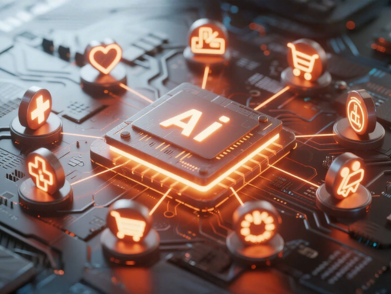
AI has become deeply woven into the fabric of our daily routines and activities. It's in smartphones, voice assistants, smart cities, and critical services. AI is also showing its capabilities in healthcare & transportation. AI is now an important part of our society. Its journey from a conceptual dream to a real-world technology reflects decades of innovation, setbacks, and breakthroughs that continue to redefine what's possible. Dominant Industries Leveraging AI Key Sectors Leading the Way in AI Adoption By 2025, artificial intelligence is touching nearly every industry, but some sectors have embraced it faster and more effectively than others: Finance Healthcare Retail & E-commerce Manufacturing Logistics & Transportation Marketing & Advertising Telecommunications These industries have seen significant benefits from AI, transforming how they operate, improving efficiency, and inspiring new business models that shape the future of their respective fields.
How Major Companies Are Pushing AI Forward
When emerging technologies hit the market, leading companies often compete to adopt and integrate them as quickly as possible. That’s exactly what's happening with AI. Tech giants like Microsoft and Google are embedding AI deep into their ecosystems. Microsoft, for example, has integrated tools like Copilot into its Microsoft 365 suite—bringing smart features to Word, Excel, and Outlook, such as predictive typing, intelligent suggestions, and auto-generated summaries. It also fuels Azure AI, offering businesses powerful development tools. Google uses AI throughout its products enhancing Search, Gmail, Google Photos, and Google Assistant with features like smart replies, real-time translation, and optimised results. Google’s innovations from DeepMind and the Gemini model drive YouTube recommendations, cloud AI services, and more. Platforms like Canva are also making big moves. Canva Ai is allowing designers to design graphic with more ease. For these companies, AI isn’t just about convenience—it’s a core driver of innovation, productivity, and long-term strategy.
AI Agents in Supply Chains: What They Are and Why They Matter
As AI becomes more advanced, expectations for what it can do are rising. One of the newest trends is the use of AI agents—intelligent software systems designed to work autonomously and analyse data without constant human oversight. AI agents have a huge demand in supply chains nowadays. They handle repetitive tasks, improve decision-making speed, and boost accuracy. Businesses use these agents to maintain operations, reduce the need for manual input and increase responsiveness. As a result, companies can move toward greater automation, better performance, and stronger customer support around the clock.
Tech Experts’ Perspectives on AI Advancement and Its Future
Although tech experts have differing opinions on AI's rapid development, many concur that it has the potential to revolutionise both industry and society. They emphasise how technology may solve challenging issues, spur creativity, and automate repetitive chores, increasing output and creating new opportunities. At the VivaTech conference in Paris, Nvidia CEO Jensen Huang stated that artificial intelligence will transform everyone’s jobs. He acknowledged that while some roles may become obsolete, many new positions will emerge. Huang emphasised that increased productivity often leads companies to hire more staff.
AI Vulnerabilities and Limitations
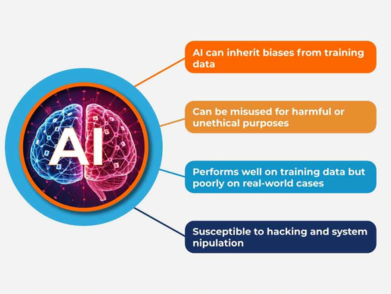
While AI brings efficiency and innovation, it also introduces serious risks. Below are the major vulnerabilities that need close attention:
1. Insufficient Testing in Live Environments: AI is still going under the training process, although we have a vast use of it. Although having huge training, AI may act unpredictably in real-world situations, which may create performance or security issues.
2. Lack of Explainability: AI models often function like black boxes. Without clear reasoning behind their decisions, trust and accountability suffer. In terms of human interaction, they show incompatibility. They use models generated by the authority.
3. Data Privacy Risks: AI relies on large datasets. If these contain personal or sensitive information, any breach can result in legal and reputational damage.
4. Adversarial Threats: Hackers can trick AI systems with manipulated inputs, causing harmful or false outputs.
5. Biased or Unexpected Results: AI can generate outputs that are inaccurate, unfair, or biased sometimes due to flawed training data or misleading prompts or from the source they get information for training.
6. Supply Chain Weaknesses: Using open-source tools and third-party models can expose AI systems to hidden vulnerabilities.
7. Shadow AI: Unauthorised AI tools used without oversight can introduce untracked and unmanaged security risks.
FAQs
What is AI?
In simple terms, Artificial Intelligence (AI) enables computers or machines to carry out tasks that usually need human intelligence.
How do you explain AI to beginners?
The capacity of machines to carry out activities that often require human intellect, such as learning, problem-solving, language comprehension, and pattern recognition, is known as artificial intelligence (AI). By learning from data and making intelligent judgements, it drives devices like self-driving vehicles, voice assistants, and recommendation systems.
What are the risks of using AI in IT?
Risks associated with AI in IT include security issues, biassed results, lack of transparency, data privacy violations, and an excessive dependence on automated systems. If not handled appropriately, these problems may affect control, justice, and trust.
Is AI expensive to implement in IT infrastructure?
A number of variables affect how AI is implemented in IT infrastructure. If it calls for sophisticated gear, big datasets, and specialised solutions, it might be costly. However, pre-built models and reasonably priced cloud-based AI technologies make adoption easier for smaller companies or simpler use cases. The complexity, scope, and particular objectives of the AI project all affect the price.
What industries benefit most from AI in IT?
Finance, healthcare, retail, manufacturing, logistics, marketing, and telecommunications are among the industries that gain the most from artificial intelligence (AI) in IT because of increased productivity, automation, and more intelligent decision-making.
